What is marketing automation?
Marketing automation covers the tools and processes used to automate repetitive marketing and communication tasks, such as contact updates, email sequences, segmentation and hand-offs between systems.
The point is not to send as many messages as possible, but to organise a flow with clear rules, accurate data and a defined purpose.
The role of the CRM
A CRM helps organise information about contacts and interactions. Connecting it to other tools can, under the right conditions, make it possible to update records and coordinate certain communications.
What is possible depends on the available integrations and on the rules by which data is collected and used.
Where can artificial intelligence help?
AI can support text processing, categorising information and some personalisation tasks, but it requires checks on data accuracy and on the appropriateness of messages.
Automating communications does not replace compliance with data protection and electronic marketing rules.
Examples of marketing automation workflows
In small and medium-sized businesses, the most useful workflows are often simple and sales-related:
- Replying to an enquiry from the website: the contact is added to the CRM and immediately receives a confirmation, while the salesperson gets a notification.
- Following up on a quote: if there is no reply after a few days, a reminder goes to the salesperson or a message goes to the customer.
- Updating contacts: data collected from forms, trade fairs or emails is added to the CRM without copying it by hand.
- Regular communications: newsletters or updates sent only to people who have given their consent.
The tools fall into three families: the CRM, which stores contacts and history; the email platform, which handles sending and unsubscribes; and an orchestrator such as n8n, which connects systems that don’t talk to each other on their own.
Our experiment: n8n, Notion and Brevo
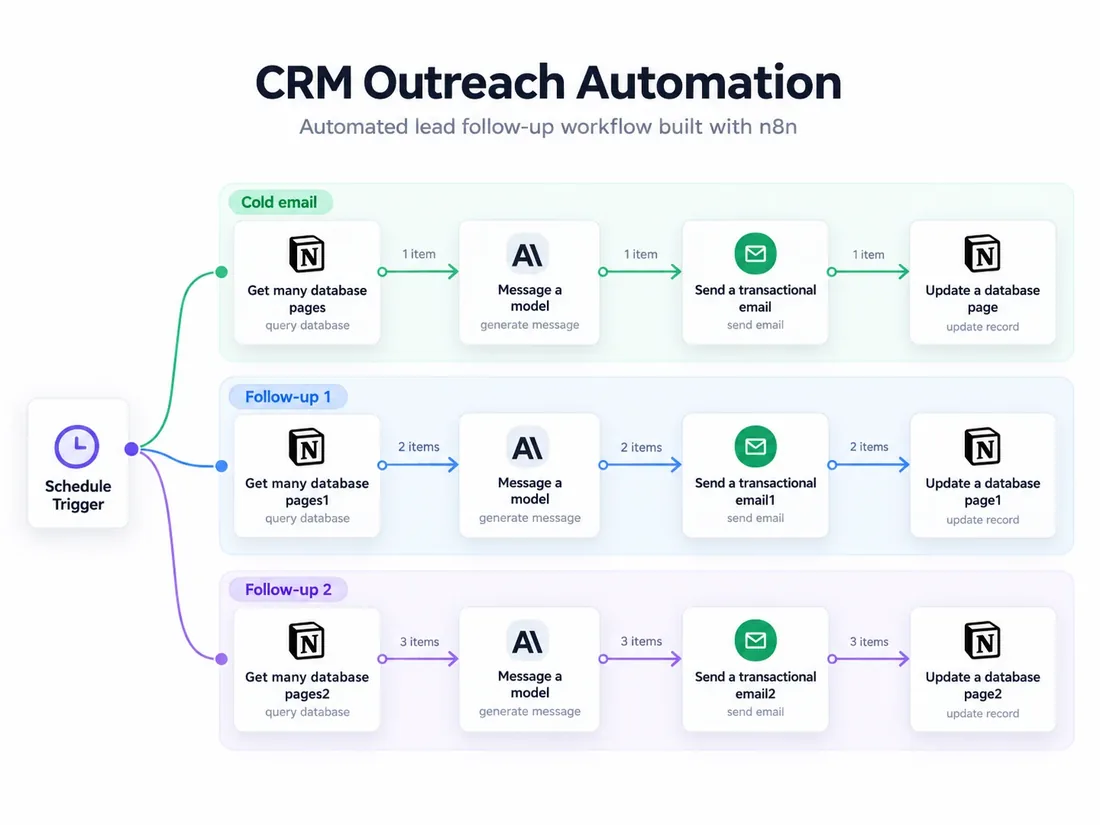
We built a demonstration workflow with three communication stages. Notion holds the data, an AI model helps write the messages, Brevo handles sending and n8n orchestrates the operations.
It is not a client case and we are not presenting measured financial results. It is a practical example of how a CRM automation can be structured.
Checks and limits to consider
In Italy, promotional emails generally require the recipient’s consent; one of the exceptions concerns similar products or services offered to existing customers, who can object at any time (art. 130, paragraph 4, of the Italian Privacy Code). Rules differ between countries, so this should be checked case by case with a professional.
Before using an automation on real communications and contacts, you need to check the legal bases, data accuracy, consent or other applicable conditions, software permissions, execution errors and how the process will be supervised.